Monday, 21 May 2012

2012 - Early season round up

The trout season is well under way now and I've grabbed some time to post a few images and musings on my experiences to date. A series of trips to the Usk, Monnow tributaries and the Barle in Devon have proved reasonably successful in what has been a highly variable start to the season.

It all started on 3rd March in high wind and squally showers at Fenni Fach on the Usk. A "blank" was the result with a glum trip home after painstaking efforts to defeat the conditions (and canoeists) in search of the fist brownie of the season. It took a change in weather conditions bringing some spring warmth in early April to turn the trout onto more consistent feeding.

First wild brownie of the season, netted at Glan-yr-Afon, Usk
My first fish of the season was netted at the Glan-yr-Afon beat on the Usk, followed by another 4 fish during an Large Dark Olive hatch, providing fantastic top-of-the-water sport. More warm weather in early April instigated some spectacular Grannom hatches as witnessed at Glan-y-Cafn, a new beat offered by the Wye & Usk Foundation, where some hefty fish were netted by myself and ever-present fishing buddy Pete (he caught his largest wild brownie here and was highly chuffed!).

A good fish taken during a Grannom hatch, succumbed to a CDC & Elk caddis pattern
Then another cold spell arrived and spring seemingly ground to a halt. Snow on the Brecons definitely affected water temperatures in the Usk catchment and the bonanza of previous weeks seemed a distant memory. The conditions were also dry once again, just as they were last year and the threat of drought became the main talking point.


Wintry scenes return to the Brecons......
.....but not cold enough to stop Pete wading into the chilly depths
Right on cue however came a prolonged deluge and everything went into spate. No fish-able beats were available now until the spates had subsided - but salmon anglers were unpacking their spey rods across the country in anticipation. For my part, a holiday to Devon was planned along with the opportunity to fish some of the famous rivers around Exmoor. The timing wasn't good however as the UK continued to soak up weather fronts full of rain, so I was restricted to one window of opportunity during a brief respite in the wet weather. I found the river Barle in full flow and very challenging to fish, but managed 3 trout as reward for my toil. The rest of the holiday was spent entertaining our two Labradors who positively revelled in the wet weather!
Alfie & Jack seemed to enjoy the wet weather during a visit to the River Barle in Devon
And it's only in the last 2 weeks that our local rivers have fined down enough for trout anglers like me to venture out again. Conditions have still been quite cold with variable results at different beats, but things seem to improving with every trip so I think spring is back on course at last; and it won't be too long before the chance to fish a long evening rise will be upon us. It took a while for the river levels to normalise, but I've been fortunate to experience some great small stream fishing as well as experience the Usk coming back to life over the last few days. Overall, a very pleasing and educational start to the season with late spring/early summer harbouring high potential.

Small stream fishing at its best - caught on the Honddu at Stanton
Escley Brook produced some tricky but exhilarating dry fly sport
Reward for patient trout-stalking at Escley Brook
Fish of the season so far - two-and-a-half pounds netted at Glan-yr-Afon

Sunday, 26 February 2012

Piscatorial Art

Christmas bought an unexpected and very pleasant surprise courtesy of my better-half. She had conspired with local artist Alison Vickery and commissioned this beautiful water colour of a wild brown trout for my Christmas present. The source material for the composition was, I'm told, taken from some of the images on this blog. The work was kept a complete secret from me and I had no inkling until the moment I opened the present on Christmas day. We've just had the picture framed in with a beautiful walnut finish and it now hangs proudly in our dining room. So thank you Sue, it's a very special gift from a very special person xxx. And thank you Alison for making Sue's idea a reality!

River Colne - 18th February 2012

Well another season is fast approaching and the anticipation is becoming unbearable. New flies are being devised on the vice and purposeful inventory checks are being made in readiness for the first opportunity to wet a line. This winter has definitely been wetter in the west compared with last year so I'm ever hopeful of a flying start to the trout season. Last year river levels in the south Wales catchment were very low at the start of the season following a dry winter with prolonged cold spells, making for a very difficult start to the 2011 season. This winter's higher than average temperatures with good flows to the rivers will, hopefully, have stimulated the insect life and in turn made the trout hungry for an early bonanza!

As if to prove the point, I had a distinctly 'trouty' encounter recently on a Grayling fishing venture on the River Colne. Along with my two fishing buddies Peter and Simon, I spent a full day searching in vain for Grayling shoals with deep nymphs, exploring every likely pool and deep water stretch. Toiling in squally rain and wind was getting the better of me, but just as some late afternoon sunshine emerged a tell-tale tug on my drifting line finally yielded a fish.....a rather splendid out-of-season trout that succumbed to a Pheasant Tail Nymph. The fight was exhilarating indicating this was one fit trout. Naturally the debate in the pub afterwards centered on whether this fish "counted for the season...". After all Simon had managed to lure one of the target species during the session and was rightly pleased. One-nil to Simon perhaps! Either way a large trout doing it's level best to rid itself of your home-tied offering feels great whatever the time of year, so roll on 1st March!!


Tuesday, 23 August 2011

Return to Pantyscallog - 20th August 2011

After what seemed like an eternity waiting for my next opportunity to fish my favourite river, I finally found myself packing the rods into the car and making the familiar trip along the A40 to Brecon Beacons. This time I was accompanied by my fishing pal Pete who had carefully negotiated his "day pass" to coincide with mine. The conversation in the car was animated, flitting between work, holidays and the state-of-the-nation. But inevitably we were soon talking "trout" - what condition would the river be in, what would the best tactics be; and so on.

On arrival at Pantyscallog it was immediately obvious we were in for a tricky session. The river Usk was very low and gin-clear with very little in the way of hatches or rising fish. This would be a day for ultra stealth tactics - keep a low profile, make delicate casts and stalk fish with utmost care.

Pete stalks nervy trout in a glide under the falls - an idyllic spot
Sure enough it took a while for things to start happening. After fruitless searches of the riffles with a duo rig, I finally spotted signs of feeding activity on a smooth glide. Several caddis species were starting to appear, along with some very small upwings, stoneflies and brook duns. A good fish was spotted within casting distance after inching my way up the glide. In went a delicate cast and within seconds the CDC & Elk was engulfed in a boiling rise. A fish was well and truly connected and a manic fight ensued with my 3WT bent almost double. The result was a fantastic wild brownie netted weighing in at just under 1 1/2 lb.

A rod-bending heavyweight prised from the water using ultra-stealth!
Another 1/2 lb fish was netted 30 minutes later on the CDC & Elk, just as Pete called by suggesting it was time for lunch - good timing Pete!

The colour and marking variations of Usk trout always amaze me - this one was almost blue!
We continued to toil after lunch. Pete had been experimenting with various patterns and was finally rewarded after lengthening his leader and netting two nervy fish on a Parachute Adams. A further three fish made their way to my net in a post-lunch purple patch. As we headed toward tea time the rises stopped and the fly life seemed to have packed up and gone for the day. But with both of us having caught in such difficult conditions, I felt we had been sufficiently rewarded. Needless to say the conversation all the way back home was predominated by plans for the next trip!

A beat with a view - a glorious way to end the day

Sunday, 10 July 2011

Pantyscallog Beat - River Crai, 2nd July 2011

A pleasing session on a very technical beat is how I'd describe this visit. The Pantyscallog beat is found at the confluence of the rivers Usk and Crai, in a very secluded setting. And it was the Crai that I'd really come here to fish, although I did have a wander down the Usk main stem just to size it up for future visits. The Crai is a classic small stream fly fishing venue and there was plenty to challenge my skills during the session. At Pantyscallog there is approximately 1 mile of fishing on the Crai (in addition to 1 mile of Usk fishing) which was more than enough for me.


Lower River Crai - looking upstream
Once again, the wild trout here are immaculate and in good fighting fettle. Although not large they gave a very good account of themselves when caught on light tackle. At the business end it was a CDC & Elk Hair caddis that brought the fish up, even in places where there were no visible rises which justly explains the opportunism of trout. Immediate reactions were required for the lightening quick rises. I must have been feeling tired because I missed loads and a few fish dropped off, but six wild brownies to the net was good going for an afternoon and evening session. Wandering back through the fields under a vivid sunset topped off a good day - I shall return!


Falls on the Upper Usk, just below the Crai - a real beauty spot

Red spotted treasure from the Crai
Pause for reflection on my way back - how lucky am I?!!

Thursday, 23 June 2011

Return to Fenni Fach - River Usk, 11th June 2011

I've had precious little time for fly fishing since starting my new job earlier this month, but I did manage to grab an afternoon a couple of weeks ago at a familiar beat. This return to Fenni Fach on the Usk proved to be very successful, although the squally showers did their best to put me off. Thirteen fish were netted during an afternoon of non-stop action, with fish rising even during the heaviest of the downpours. X-caddis, Copper John and LT Klinkhamer Special all proved to be fish-takers and the trout were fighting fit. One fish in particular was very memorable, which rose to the LT Klink and was nudging 2lb according to my scales. As indicated below, it had a tail like a shovel and took some careful coaxing to get the beast into the net. A highly satisfying day and well worth the visit!

A pristine Fenni Fach brownie succumbs to an X-Caddis
Fin-perfect. The shovel-tailed 2-pounder
The spots on this fish were as vivid a I've seen on an Usk trout

Monday, 30 May 2011

My first small stream venture - Lower Stanton Beat, Honddhu - 27th May 2011

'R39' will live long in the memory, for lots of good reasons. It was on 'R39' that today I achieved a long-held ambition to fish a truly wild small water. I've been building up to this for a little while now as this is probably the most technically difficult aspect of fly-fishing. Today's challenges comprised a potent mixture of low water, wind, overhanging trees, nettles, spooky fish, cow-dung and a barely-used new rod to get used to. But in the face of all these challenges, 'R39' yielded 11 of the most beautiful wild trout anyone could hope to catch; including two 12inch specimens which really topped a great day.

Ok, ok....so I got a little help. Well quite a bit actually. In a bid to accelerate my understanding of how to approach small streams, I asked Gareth Lewis to guide me through the day. Small stream fly fishing is Gareth's sweet-spot and I have to say I have benefited immensely from his careful tuition. He covered everything including set-up, fly selection, stealth tactics, casting options and reading the water. There was continued advice on ironing out casting difficulties and plenty of animated conversation about the art of small stream fishing. Put simply, I couldn't have chosen a better guide.

It was Gareth's recommendation to go to 'R39', which is the Lower Stanton beat of the Honddu. This is a Wye tributary that meanders through the meadows of the Honddu Valley. Here there are enough riffles, flat glides and deep pools on the beat to fill an entire day of fishing.
Using stealth tactics I get into position....

...while Gareth points out the local fly life
Fishing got underway in the morning which was still chilly and fresh from the night. This made for a slow start although a couple of early fish were hooked but dropped off. The fly activity was very sparse at this stage, but things started to pick up as lunchtime approached. Very gradually the hatches got underway as conditions warmed up. Thanks to Gareth, my casting was steadily improving as I got used to the new 3 WT rod. Two fish in quick succession to an X-Caddis was a good sign that things were beginning to gel.
The first fish to be successfully netted

Small but perfectly formed 
Some bemused onlookers
The highlight of the day came after lunch. A couple more fish had been netted when Gareth spotted some interesting rises in a feeding lane under over-hanging trees. We both observed emerging Mayfly (Ephemera sp.) being taken, so I was a little surprised when Gareth tied on a Mayfly spinner and prompted me to cast at the rising fish. The fly was huge and I had difficulty casting it to the right spot. Another more aerodynamic fly was substituted - but it was still a large spinner pattern. Shouldn't we be trying an emerger or dun?!! This time however I was able to deliver the fly to the right spot, just upstream of where we thought the fish was holding. The fly drifted a short while and then the rise came. It was immediately apparent I was connected to a good sized fish; and strong too. This was what I came for - light tackle and fit fighting trout. I blurted out "I'm not stopping for a photo....". Back came the call from Gareth "Give it some line if it wants to go..." . Can you guess who was in a more rational state-of-mind at this point? It certainly wasn't me! But I had been squatting in cow dung and had acquired nettle stings in my bid to catch this fish! The chaotic scrap ended with a 12 inch beauty in the net - and a very knowing smile right across Gareth's face.

Trout lunch. Gareth and I had scampi

With a 12 inch scrapper netted, I finally stop for a photo

Another nice fish prised from very low flat water in the evening
Finally , special thanks to Gareth for allowing me to use his photos in this article; and to 'R39' for yielding some of her secrets.

River Frome - May 2011

During my week off work I decided to focus on my next piece about the River Frome. This is the second installment about my local river and one tinged with sadness and concern.

For this piece I had hoped to capture some of the delights of the upper reaches of this little trout river. I took a walk through Siccaridge Wood near Sapperton, where the path of the Frome winds its way through the beautiful Costwold countryside, woodlands and meadows on its way to Stroud. At this time of year I've previously observed May Flies (Ephemera sp.) and Kingfishers, both of which are good indicators of a healthy river environment.

This time however, there was no river. All that was visible was simply the bare bones of the river bed like some fossilized relic hinting at a previous existence. Consequently, no Mayfly observed; no trout observed; and no kingfishers observed. An entire ecosystem has disappeared.
Dried up gravel bed with land-based plants beginning to colonize
Gloucestershire is a notoriously wet county but we've had a few significantly dry winters in recent years and I suspect this is the primary reason for the absence of flowing water in this stretch of the Frome. The river is spring-fed from sources further north, up as far as Birdlip. The natural springs in the hills where I live are bone dry at present and this is probably the case with the source springs of the Frome. I have heard some worrying stories of farmers routing spring water in a bid to avoid the cost of water being supplied by water companies. If that were true it would have a marked deleterious effect in the present circumstances, but would be relatively unnoticed in 'normal' conditions.
This stretch should be at least knee-deep. Wouldn't you just love to fish it?
If conditions do return to more typical cycles of mild, wet winters then there's every chance this stretch of the Frome will recover. Nature is always quick to re-colonize, often in spectacular style, but it will take a couple of seasons once the flows do return. For now, let's hope the lower reaches of the Frome, where aquatic wildlife currently thrives, does not fall victim to the diminishing water table.

Sunday, 29 May 2011

Glan-yr-Afon beat, River Usk - 24th May 2011

So finally some rain came and it seemed to do the trick. Knowing I had a week off work I had been watching the weather forecasts carefully a few days prior to booking my next visit to the Usk. The forecasts were just about spot on (for a change!) and I observed a slight increase in the river level. So, fueled with optimism I ventured to an unfamiliar beat to see what could be gleaned. The Glan-yr-Afon beat is stunningly pretty and I'm most envious of the locals who live in the village just above the bridge. From an angler's point-of-view this beat has a lot to offer. There's much to explore in the form of numerous riffles, pocket water and flat glides all in a very tranquil setting.

Glan-yr-Afon beat looking downstream. Fishing heaven?!
And today the fishing was good. Despite a stiff downstream breeze and bright sunshine only periodically dimmed by spring clouds, it seemed the recent rain had freshened things up and made the trout a little more active. The fly activity was good with plenty of upwings hatching, including quite significant numbers of Yellow Mays. There were caddis flies about also, so plenty to get the fish interested.

Fish kept on rising throughout the day, albeit rather sporadically. But there was enough to give me hope and the opportunity for targeted casting, rather than just searching the water. Fishing predominantly with an olive Klinkhamer plus a copper john fished NZ style, I was rewarded with 8 brown trout and 1 salmon parr. All fish were in pristine condition and fought hard before reaching the net.


Two pristine examples of the Glan-yr-Afon trout
But there was one fish in particular that made the whole trip worthwhile. In the late afternoon I was making my way back from the upstream limit of the beat when I decided to stop at one of the more productive riffles. I'd seen some rises so made my way to the bottom of the riffle and started to fish upstream. Looking across to the far bank I noticed a rise behind a boulder. I kept my eye on the boulder for while and then it dawned on me what was there - a BIG fish! And it was feeding voraciously, flashing side-to-side taking in nymphs with just the occasional rise signalling its location. By now my rig consisted of a  Klinkhamer with a Yellow May spider pattern on the point. Not exactly a classic combination but something I had been experimenting with, given the significant numbers of Yellow Mays hatching off. The spider (under the Klink) had already accounted for one fish so I saw no reason to change things now. My main concern was getting a decent cast to the boulder, taking into account the presence of 2 tongues of fast water between me and the target. Out went a pile cast which miraculously got the flies to the right spot first time. I saw them drift momentarily around the side of the boulder and then a huge boil in the water followed. I lifted and to my total amazement I was connected. An exhilarating fight ensued with the fish leaping clean out of the water 3 times. After what seemed like an eternity a fin-perfect 16 inch wild brown trout filled my net.
The hard fighting specimen is safely returned. Fish of the season so far!
And the successful fly? The Yellow May spider, of course! So I now proudly declare the Klinkhamer + Yellow May spider to be a "classic" fish catching combination!
The successful Yellow May Spider. Now a bit tatty after todays exploits!

Sunday, 1 May 2011

River Usk - Mardy Beat 29th April 2011

A few too many weeks have passed since I last cast a line so today's session was eagerly anticipated. It turned out to be a great day and was made all the more pleasurable by the company - my pal Peter who is getting back into fly fishing after few joint trips last season; and Gareth, our guide for the day who ensured our fishing skills were up for the challenge!

And once again, what a challenge it turned out to be. No rain for weeks and unseasonably warm weather has ensured the Usk remains low, clear and bereft of the usual fish-catching opportunities that might otherwise be expected at this time of year. Add the brisk north easterly wind and we knew on arrival that it wasn't going to be easy.

Enter Gareth, our guide for the day. Gareth Lewis of FFISW fame has recently launched his professional guiding service. After some discussion Peter and I decided to hire Gareth's services at this relatively early stage of the season to brush up on our skills and learn some new tricks of the trade. We were not disappointed.

Anyone out there considering the services of a guide in the South Wales catchment, you need look no further. Gareth’s whole approach to the session was spot on. He is undoubtedly an expert and has a great deal of knowledge anyone can benefit from. Above all Gareth gave me and Pete the space to try what we’d learned making the whole session relaxed, easy going and fun.

Despite the tough conditions Gareth got Pete and I into fish, both on the long flats and in the riffles. It was nice to see a few fish rising on this beat and there was decent variety of upwings, sedge and midge coming off throughout the day. Both dry fly (emerger patterns) and small nymphs fished New Zealand style induced many takes between 11am and 4pm. Successfully connecting to fish proved to be quite a challenge - I know I'm a little rusty at present with my timing. Nevertheless, both Pete and I each managed two fish to the net which was reward enough for our efforts.

At the end of the day it was smiles aplenty as we shook hands with Gareth and thanked him for a superb day. Pete and I would also like to take this opportunity to thank the Methyr Tydfil Angling Association for allowing us the opportunity to fish this fantastic beat.

Now, let's pray for rain.......!!


Not exactly monsters, but hugely satisfying catches that topped a hugely satisfying day
[Images reproduced by kind permission of Gareth Lewis Fly Fishing]

Tuesday, 29 March 2011

River Frome - My local

This post is a bit of a diversion from my previous musings as I wanted to highlight the virtues of my local river - and tip a wink to a very friendly chap called Clive.

I was shopping in my local town, Stroud, one Saturday a few weeks ago, when I decided to visit the office of the Cotswold Canals Trust (CCT), mainly out of curiosity although I must admit to having a slightly "trouty" agenda when I entered. The background to this is simple. The CCT are leading a major project to renovate the old Stroudwater Navigation canal, which in years gone by was part of a major commercial link between the River Severn and the River Thames. Stroud was one of the hubs of the wool and textiles trade in the Cotswolds and the ability of local businesses to move goods east and west via the Stroudwater route was vital to the local economy. The emergence of rail and road links in the early 19C introduced competition to Stroudwater and eventually it fell into disuse in the 1950s as modern transportation took over. The canal has since fallen into a state of disrepair, but is now the subject of major renovation that ultimately aims to recreate the entire link between the Severn and the Thames.

So what does this have to do with trout??

Quite a bit as it turns out. Because running alongside much of the Stroudwater route is the River Frome. This little river has been a subject of interest for me since I first noticed a small but thriving wild brown trout population in her waters. These little trout must be some of the most resilient known to man. For starters much of the upper reaches of the Frome where the trout live runs through Stroud via several industrial estates and parallel to the main line that links London to Cheltenham. So it's a real urban backwater with all the associated environmental challenges. Additionally, much of the bankside is overgrown - positively wild in some spots. This creates high silt levels from annual leaf fall in some areas; not so great for trout breeding. Finally the river seriously burst its banks during the infamous 2007 summer floods.Yet despite all this, if you know where to look, I guarantee you'll find healthy and very active trout.

River Frome at Brimscombe Port, east of Stroud

Which brings me full circle to the CCT and the visit to their office in Stroud. My curiosity was driven by the CCT renovation and its impact on the Frome. Enter Clive Field, the very welcoming Visitor Centre Manager. Clive very kindly organised a cup of tea for me and talked at length about the CCT mission and how volunteers can get involved. We discussed the close linkage between Stroudwater and the Frome, as well as the mutually beneficial activities of the CCT renovation in regard to the local environment. Specifically, one of the mission objectives of CCT is "To promote the restoration of the two waterways [Stroudwater Navigation and The Thames & Severn Canal] to give a balance between the needs of navigation, development, recreation, heritage, landscape conservation, wildlife and natural habitats"


I'm sure the Frome can significantly benefit from the renovation project and there's a great opportunity here to ensure both waters enhance each other for the benefit of all those who visit, as well as the local wildlife.

A trouty glide just upstream from Brimscombe Port

Clive has a huge amount of passion for Stroudwater and his energy was infectious. I think he sensed an opportunity when I shared my passion for fly fishing and highlighted my interest in the Frome. I'm now on the hook to write an article for the CCT's member magazine! Actually it's an honour and a privilege to be asked, so I'll give it my best shot. The article is intended to highlight the flora and fauna that can be found on the canal route and surrounding environment at this time year. No doubt I'll try to slip in a line about the local brown trout!

As for this blog, I intend to document a year in the life of the Frome and try to observe how the environmental characteristics of the river support the trout population. Without being overly scientific, I'll endeavour to discover the underlying entomology which the trout vitally feed upon, as well as identify where their breeding environments might be found. Who knows, one day I might be presiding over a major new trout fishery - right on my doorstep!

A Frome trout - this one was feeding and rising to midges

Sunday, 27 March 2011

Penpont, River Usk - 20th March 2011

Well I said I wasn't expecting a bonanza and I was right! Sunday 20th March saw me loading the car for my first outing of the season, and long overdue it was too. 2 hours of driving later (taking in the beautiful scenery of the Forest of Dean and then the Brecon Beacons) and I was eagerly setting up my 5 WT, complete with new reel. My newly tied flies, as per previous posts, were packed ready and I was soon walking the familiar route over the bridge at Penpont House to start making my way downstream over the fields. The season had really started for me at last! Ewes and their lambs ambled casually across the grassy hills; the sound of buzzards could be heard high in the sky; nobody else was in the vicinity; and the Usk herself called with the sound of rapids full of promise.

And now the reality-check....cue sound of needle being scratched across vinyl record....

The skies were foreboding. Morning calm had given way to a penetrating westerly which whipped up between the river banks like a wind-tunnel. Although it was supposed to be around 11C, it felt much colder in the wind. The river was incredibly low too, almost as low as it got last summer. The water was gin clear and despite a modest hatch of Large Dark Olive, as well as tiny midge, I didn't see a single fish rise the whole day. In fact I didn't see a single fish at all, apart from some shoals of fry in the shallows (one good sign after the winter we've had).

River Usk at Penpont - rather low at the moment!
 I decided my tactics would be to focus on some of the deep gullys and try to fish them upstream with short casts. I used my tungsten weighted Baetis nymphs and midge larvae, all fished deep on a dead drift. I tried a few lifts periodically, particularly with the Baetis nymph to see if I could induce a take. All this amounted to nothing. Not even the slightest hint of a take for the whole session, which lasted from 11am to 4pm.

A newly hatched Large Dark Olive (Baetis Rhodani)
So I'm sorry to report that for the first time since I started fishing on the Usk, I blanked. But no matter. Just being there was what it was all about, Moreover, after a long absence over winter, I felt confident and happy with my tactics. A winter spent researching and reading has equipped me with new knowledge which I began to apply on this visit and I shall, no doubt, be a better angler for it. Afterall, if it was instant gratification that I desired I could have just as easily parked up at a stocked lake and almost guaranteed myself some action. That kind of gratification wasn't on my agenda today. I went home having blanked but still satisfied - just not sure I can fully explain why!!

The new reel sees some action at last!


Friday, 18 March 2011

Penpont beckons

At last I have my first session of the new season arranged with a booking on the Penpont beat of the Usk this Sunday. The trickle of early season reports have certainly wet the appetite, albeit that the fishing is quite slow with only sporadic hatches of LDOs and midge observed so far. Based on the flies I've tied to-date I'm feeling reasonably prepared but I won't be expecting a bonanza.

My last few tying sessions have been focused on the March Brown, for which there are various recommended patterns. Here are a couple of simple 'spider' based variants which I've produced.


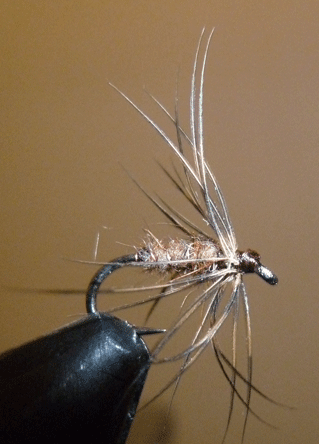
#14 March Brown variant 1 - with tail


#14 March Brown variant 2 - no tail
March Browns generally hatch in April so I may not get a chance to test these for a few weeks. But the weather is set fair this weekend so I'll be on the look out for any opportunity to fish these patterns. My guess is that patterns like this may prove to be quite versatile and could be deployed to imitate any of the large dark upwings. I'll give them a go throughout the season and post my findings.

Sunday, 27 February 2011

Countdown part 3 - and the rest....

Less than 1 week to go now and preparations are well under way. I've added some more trout-tempting morsels to my armoury including some Midge emergers and Baetis nymphs and adults. I'm still focused very much and the small end of the size spectrum as I'm enjoying using my new vice with its "midge jaws".

One of my regular go-to flies last season was a tungsten head Pheasant Tail Nymph (PTN) which is a highly versatile nymph representation. I make these up in sizes 16 down to 22 and usuually add some flash to the thorax. The type of tungsten bead I use varies also from black, to gold and to silver. This has been a real fish-catcher for me in the past so I always make sure I have some tied and ready to go.

#20 Pheasant Tail Nymphs
These PTNs should take fish when the early spring Large Dark Olive hatches are underway. During these hatches and when the trout start looking upwards for their food, emerger and adult representation should bring success. I've prepared some RS2 designs in various shades of olive with size #20 and #22 hooks. These are really simple to tie so a great choice when starting fly-tying at the small end of the scale. I found the micro-fibbets (tails) a bit fiddly at first, but there's a great video (here) on how to tie a RS2 which really helped me. It includes a really neat tip on using the tag-end of your thread to split the tails.


#20 Olive RS2
On the midge front, I've expanded on the larvae imitations from the previous post to include some pupae and emerger representations that should be fished higher in the water as midge hatches develop. Here are two examples - a grey midge emerger with some UV Krystal Flash as the main trigger point; and black spider patterns with a small soft hen hackle plus a little flash for a trigger point.

#22 Grey Midge Emerger

#22 Black Spiders with a flash trigger
Finally, I'm doing some research into March Brown patterns so I hope to post some new ties in the next 'Countdown' entry.